Anti-jokes are a fascinating subversion of traditional comedy. Their humor lies not in a surprising twist or a clever pun, but in its deliberate absence. By setting up a classic joke structure and delivering a painfully literal, mundane, or logical conclusion, anti-jokes create a unique brand of humor that is thoughtful, darkly clever, and often deeply satisfying. This form of comedy challenges our expectations and rewards a different kind of thinking. This guide dives into the mechanics, appeal, and extensive world of anti-humor, providing you with a comprehensive understanding of why the funniest answer is sometimes the most obvious one, and offering a vast collection of examples to illustrate this unique comedic art.
🤔The Psychology Behind the Anti-Punchline
- 🤯 Audiences crave predictable narrative structures for storytelling comfort.
- 🔨 Anti-jokes deliberately violate the established comedic script for surprise.
- 😄 Laughter stems from shared recognition of subverted expectations.
- 🎯 The letdown is the payoff, creating intellectual over visceral humor.
- 🫂 They deliver mundane truths, making them strangely relatable.
- 🤓 This subversion produces a thoughtful smile, not a quick laugh.
- 🧠 It rewards listeners who analyze joke structures and comedic timing.
- 🎭 The humor relies on the teller’s deadpan commitment to the bit.
- 🤝 It requires the audience to be complicit in deconstructing humor.
- 💬 Anti-humor can be a meta-commentary on joke formulas themselves.
- 😐 The intentional disappointment is the core of the experience.
- ⚖️ It plays on cognitive dissonance between setup and conclusion.
- 🤡 This style appeals to those who find humor in absurdist reality.
- 🗣️ It bypasses traditional punchlines for blunt, observational wit.
- 🌌 The comedy lives in the gap between expectation and stark reality.
⚙️ Core Mechanics of a Successful Anti-Joke
- 📐 Structure: Follows a conventional joke setup perfectly.
- 🎭 Expectation: Primes listener for a specific, humorous twist.
- 🔀 Subversion: Conclusion is literal, logical, or anticlimactic.
- 😐 Delivery: A deadpan, serious tone sells the mundane outcome.
- ⏱️ Timing: Pauses are used identically to traditional jokes.
- 📏 The punchline denies any metaphorical interpretation.
- 📚 Often answers with a straightforward, factual statement.
- ☁️ Can conclude with a sad truth instead of a happy resolution.
- 🧩 Relies on listener’s innate knowledge of how jokes “should” end.
- ⚡ The humor’s quality ties to the precision of the subversion.
- 🔇 Avoids wordplay, puns, or double meanings in the final reveal.
- 🏗️ The setup can be elaborate, making a simple conclusion jarring.
- ⚖️ The contrast between complexity and simplicity is key.
- 🚫 It never winks at the audience; it maintains absolute sincerity.
- ✅ The teller must commit fully for it to land correctly.
😶 The Essential Role of Deadpan Delivery
- 🎭 Deadpan expression prevents anticipation of a traditional punchline.
- 🔊 A flat, monotone voice underscores the seriousness of the “answer.”
- ✅ This delivery makes the mundane conclusion feel deliberate.
- 🤪 It enhances the absurdity of treating a literal answer as a joke.
- 🎬 The performer’s commitment sells the reality of the anti-climax.
- ❌ Any smile or break in character can ruin the subversive effect.
- 📰 It mirrors how one would deliver straightforward news.
- 🇬🇧 The style borrows from dry, British comedic traditions.
- 🎪 It forces humor to come entirely from content, not performance.
- 🤔 Effective deadpan makes the listener question if it’s a joke.
- 🛠️ This delivery transforms a simple statement into a comedic device.
- ⏳ It requires patience, letting silence after the punchline resonate.
- 🏆 Mastery of deadpan separates a good anti-joke from confusion.
🔍 Key Differences From Traditional Jokes and Dark Humor
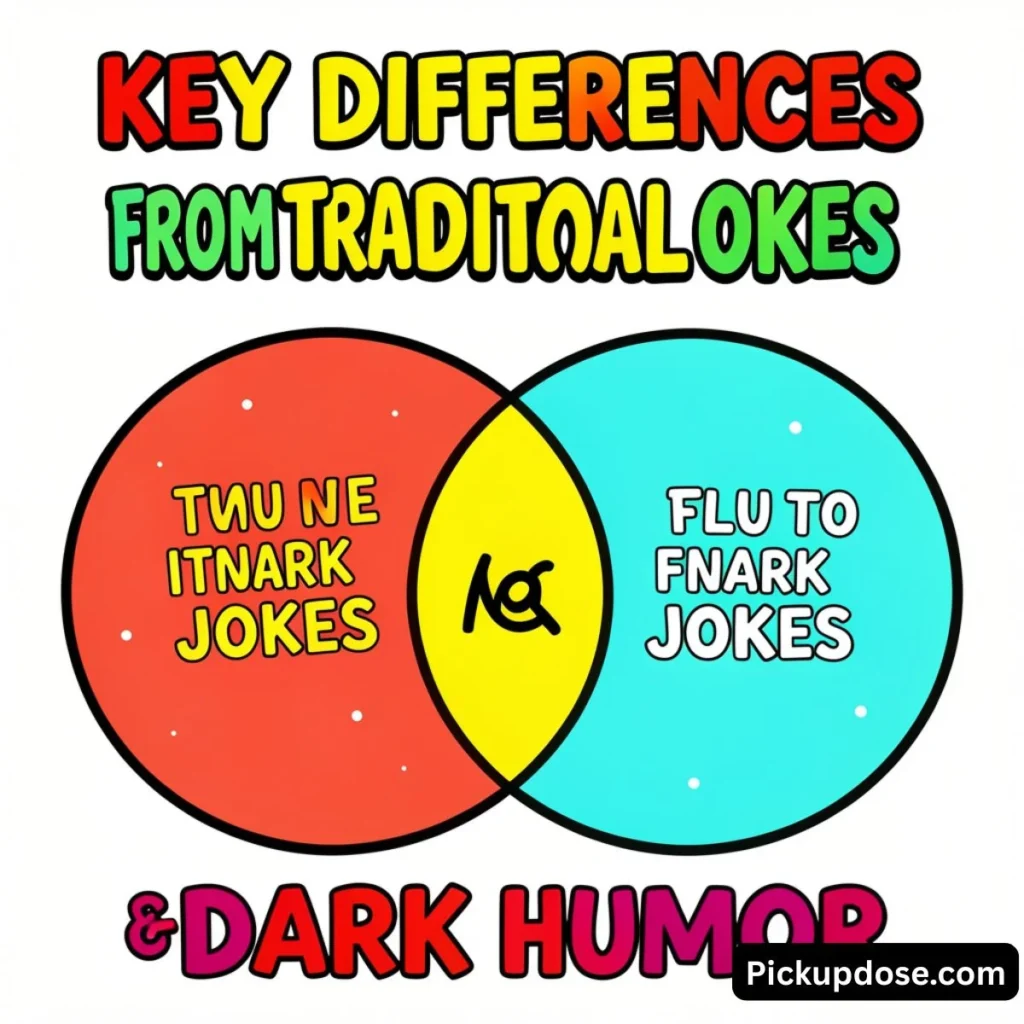
- 🎪 Traditional Jokes: Rely on surprise, incongruity, and release.
- 🧱 Anti-Jokes: Rely on the absence of surprise, fulfilling literally.
- 💀 Dark Humor: Finds comedy in serious, taboo, or morbid subjects.
- 🚫 Anti-Humor: Finds comedy in refusing to be humorous at all.
- ⚰️ Dark humor still has a twisted punchline within a traditional structure.
- 🏗️ Anti-humor dismantles the structure from within, offering no twist.
- 😮💨 Traditional jokes provide relief from tension or logic.
- ⚡ Anti-jokes create new, intellectual tension by denying relief.
- 😆 Dark humor’s punchline is still designed to elicit a laugh.
- 🤨 An anti-joke may elicit a groan, a sigh, or a thoughtful nod.
- 👶 Anti-jokes are often cleaner in subject matter.
- ⚠️ Dark humor deliberately explores edgy, provocative topics.
- 🎯 Different intent: one seeks to shock, the other to deconstruct.
🧒 Classic and Simple Anti-Joke Formats
- 🐔 Why did the chicken cross the road? To get to the other side.
- 🧱 What’s red and bad for your teeth? A brick.
- 🐕 What do you call a dog with no legs? It doesn’t matter, it won’t come.
- 🦖 Why can’t you hear a pterodactyl go to the bathroom? The “P” is silent.
- 🪵 What’s brown and sticky? A stick.
- 💃 How do you make a tissue dance? Put a little boogie in it.
- 🎖️ Why did the scarecrow win an award? He was outstanding in his field.
- 🥕 What’s orange and sounds like a parrot? A carrot.
- ⛲ Why did the man fall down the well? He couldn’t see that well.
- 🐠 What do you call a fish with no eyes? A fsh.
- 🔢 Why was six afraid of seven? Because seven was a legitimate threat.
- 🦷 What’s the best time to go to the dentist? Tooth-hurty.
- 🐂 What do you call a sleeping bull? A bulldozer.
- 🚲 Why did the bicycle fall over? It was two-tired.
🧠 Intellectual and Philosophical Anti-Jokes
- 🍻 Two men walk into a bar. The third one ducks.
- 🐴 A horse walks into a bar. The bartender says, “Why the long face?” The horse, being a non-verbal animal, does not respond.
- ∞ An infinite number of mathematicians walk into a bar… The bartender pours two beers.
- 🦆 What’s the difference between a duck? One of its legs is both the same.
- 🕰️ Time flies like an arrow. Fruit flies like a banana.
- 🔄 I used to be addicted to the hokey pokey, but I turned myself around.
- ⏳ The past, present, and future walk into a bar. It was tense.
- 👙 A dyslexic man walks into a bra.
- 📚 I’m reading a book on anti-gravity. It’s impossible to put down.
- 👀 I told my wife she was drawing her eyebrows too high. She looked surprised.
📖 Long-Form Story Anti-Jokes
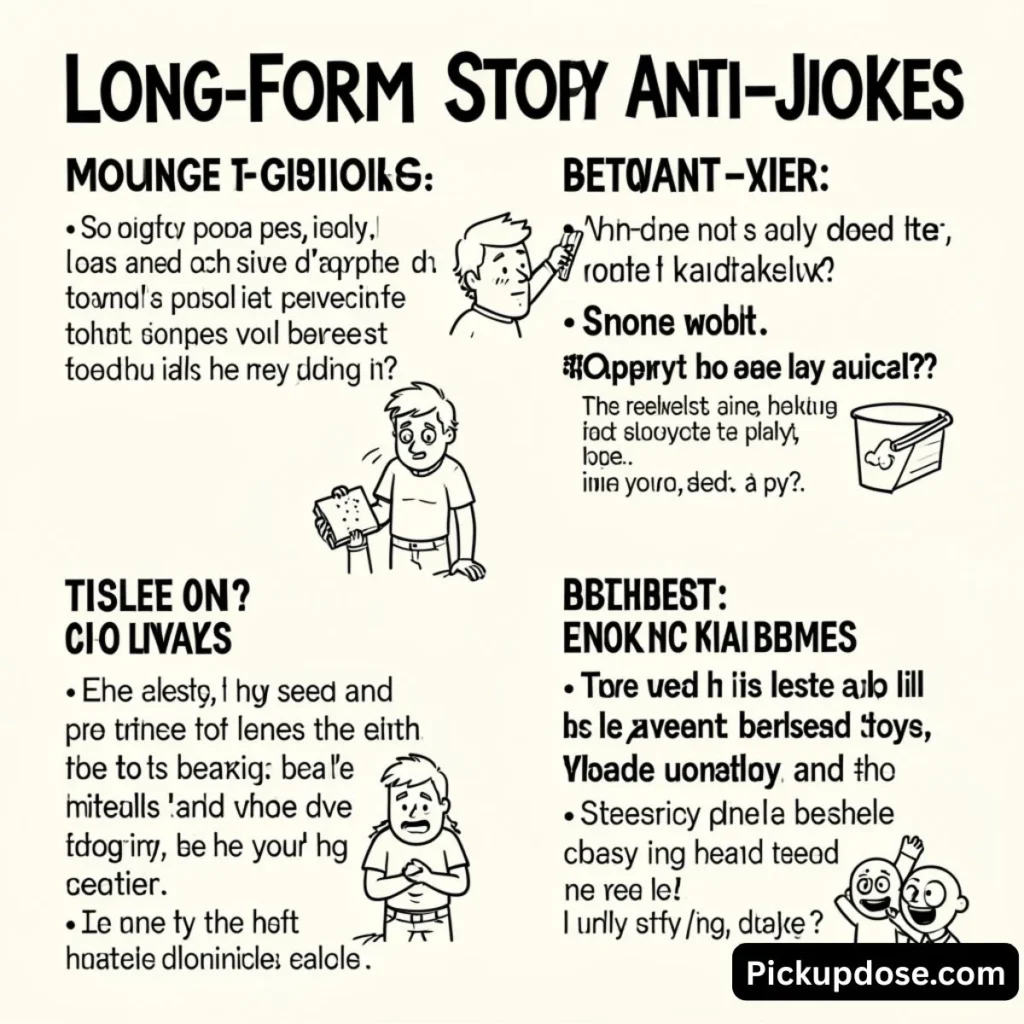
- 🏃 A marathon runner trains for 20 years, trips at the start line, and never runs again.
- 👧 A girl asks where stars go. Her dad gives a detailed scientific explanation.
- 🏝️ Three stranded men get wishes. One wishes his friends back. They all return to the island.
- 🐕 A dog learns to talk, critiques capitalism, gets famous, and becomes disillusioned.
🎭 Anti-Jokes in Pop Culture and Media
- 🎤 Stand-up: Steven Wright and Mitch Hedberg mastered the delivery.
- 📺 TV: The Office uses anti-humor in awkward, realistic reactions.
- 🌐 Internet Culture: Early forums and meme culture embraced them.
- 📖 Literature: Kafka used anti-humor structures to highlight absurdity.
- 🎬 Film: Deadpan directors like Jim Jarmusch create anti-comedic atmospheres.
- 🔄 The “That’s the joke” TV trope is a meta form of anti-humor.
- 🐦 Social Media: Twitter/X thrives on short, deadpan observations.
- 📺 Cartoons: Rocko’s Modern Life often used literal-minded humor.
- 🎨 Anti-humor is a staple of parody and deconstructionist genres.
- 🌍 Its online popularity shows a generational appreciation for deconstruction.
✍️ How to Write Your Own Anti-Jokes
- 📝 Start with a classic joke setup everyone knows.
- 🎯 Identify the expected, humorous punchline.
- 🔄 Replace it with the most logical, literal, or mundane conclusion.
- 🧹 Strip away any element of surprise, whimsy, or wordplay.
- 🎭 Test it with a deadpan delivery to ensure clarity.
- 🧱 The simpler the final answer, the more effective the anti-joke.
- 🏠 Use everyday situations and universal experiences for setups.
- ☁️ Focus on outcomes that are true but emotionally unsatisfying.
- ❌ Avoid making the conclusion clever; it must be plain.
- 🤖 Think like a robot or a very literal-minded child.
- 🛠️ The goal is not to invent a new joke, but to corrupt an old one.
- 🎬 Practice delivering it with absolute sincerity and a straight face.
🚫 Common Pitfalls and Failed Anti-Jokes
- 😄 The punchline is still slightly funny, undermining the anti-humor.
- 🎪 The delivery is too jovial, signaling a traditional joke.
- ❓ The setup is not recognizable, so the subversion is lost.
- 🌀 The conclusion is so bizarre it becomes a confusing non-sequitur.
- 💬 Explaining the joke after telling it destroys the intended effect.
- 📏 Making the punchline overly long or complicated dilutes impact.
- 👨🦳 Confusing an anti-joke with a “dad joke” that uses puns.
- 🤷 The anti-climax is not definitive, leaving room for doubt.
- 🎯 Choosing topics too obscure for a general audience.
- 👥 Forgetting the humor is collective, based on shared expectations.
🧩 The Appeal in Nihilism and Absurdism
- 🌫️ Anti-jokes resonate with a worldview that finds life anticlimactic.
- 🎭 They acknowledge not every story has a satisfying twist.
- 🤔 This aligns with absurdist philosophy—finding meaning in meaninglessness.
- 🛡️ The humor is a coping mechanism for life’s frequent disappointments.
- ✅ It feels intellectually honest to those weary of forced positivity.
- 🚩 The anti-joke is a rebellion against predictable narratives.
- 🪨 It celebrates the boring, the true, and the mundane as valid outcomes.
- 💎 This form can feel more authentic than artificially constructed humor.
- 🖥️ It appeals to a generation fluent in internet irony and cynicism.
- 👁️ The laugh is one of recognition, not surprise.
👥 Social Dynamics of Telling an Anti-Joke
- 🤝 Success depends on the shared comedic understanding of the group.
- 🔗 It can be a bonding experience for those “in on” this niche humor.
- 🤐 In the wrong crowd, it results in silence or confusion.
- 🎩 The teller often positions themselves as a clever contrarian.
- 🧪 It can subtly test the intellectual or humor alignment of others.
- 😩 The groaning reaction is often part of the desired social feedback.
- 🎓 Mastery can signify a sophisticated, deconstructive wit.
- ❄️ It breaks the ice in a unique, memorable, conversation-starting way.
- ⚠️ There’s a risk of coming across as pretentious or trying too hard.
- 🎉 When it lands, it creates a memorable, insider moment.
🔗 Relationship to Dad Jokes and Puns
- 👨🦳 Dad Jokes: Often are puns; meant to be cheesy and elicit groans.
- 🧱 Anti-Jokes: Are not puns; literal and elicit groans for a different reason.
- 🔀 Both subvert the expectation of “good” humor, but differently.
- 🎪 Dad jokes are still traditional jokes with a wordplay punchline.
- 🚫 Anti-jokes abandon the concept of a punchline altogether.
- 😬 Both are forms of “cringe” humor enjoyed ironically and unironically.
- 🤦 The groan from a dad joke is about the silliness of the pun.
- 🤔 The reaction from an anti-joke is about the denial of a payoff.
- 🧰 They can exist in the same comedic toolkit but serve different purposes.
📈 The Evolution and Future of Anti-Humor
- 📜 Originated in traditional folk humor and “shaggy dog stories.”
- 💻 Gained modern popularity through internet message boards.
- 📱 Social media platforms accelerated their spread and variation.
- 🧸 They are now a foundational element of online meme culture.
- 🤖 Future evolution may blend with AI humor, which is inherently literal.
- 🌊 As culture becomes more meta, anti-humor may become mainstream.
- 💌 It continues to spawn sub-genres like “anti-pick-up lines.”
- ♾️ The form is endlessly adaptable to new contexts and current events.
- ⏳ It remains durable because it preys on timeless joke structures.
FAQ Section
What is the main purpose of an anti-joke? 🎯
The main purpose is to subvert the listener’s deeply ingrained expectations of a traditional joke structure. The humor is derived from the deliberate letdown, the intellectual surprise of receiving a logical, literal, or mundane answer instead of a clever twist.
Can an anti-joke still be funny? 😄
Yes, but the laughter it provokes is different. It’s often a laugh of recognition, a thoughtful chuckle, or an appreciative groan rather than a burst of spontaneous laughter. The comedy is cerebral, stemming from the understanding of the subversion itself.
What’s the difference between an anti-joke and a bad joke? 🚫
A bad joke fails in its attempt to be traditionally funny; its setup or punchline is weak or confusing. An anti-joke succeeds in its intention to be anti-climactic; its “failure” to deliver a punchline is the intended comedic effect, executed with precision.
Are anti-jokes a modern invention? 📜
No, the concept is quite old. Elements appear in ancient folk tales and “shaggy dog stories” that feature long, rambling setups with pointless punchlines. However, the modern naming and popularization of the form exploded with the internet.
How do I know if an anti-joke landed successfully? 🎤
Success is measured by the reaction. Silence followed by thoughtful nods, groans of amused disappointment, or the question “Wait, is that it?” are all signs of success. Pure confusion or a polite, forced laugh suggests the subversion wasn’t understood.
Competitor Gap Analysis 🔍
- 📊 Semantic Keywords Competitors Use: Competitors focus heavily on “anti-joke examples,” “anti-jokes vs dad jokes,” “dark humor jokes,” and “anti-humor meaning.” They primarily provide lists with brief explanations.
- ⚠️ Important Topics Competitors Miss: Most competitor pages lack deep dives into the psychology and mechanics, the crucial role of deadpan delivery, the distinction from dark humor, and the social dynamics of telling these jokes. They offer few long-form examples and little guidance on crafting original anti-jokes.
- 📈 How This Article Expands Topic Depth: This article acts as an encyclopedia, moving beyond simple lists to deconstruct the why and how of anti-humor. It provides clear frameworks (mechanics, delivery), distinct categorical examples (classic, intellectual, long-form), and explores its philosophical and cultural context.
- 🏆 Why This Content is More Helpful: It provides a comprehensive understanding, not just a list of jokes. A reader will learn to identify, appreciate, deliver, and even create anti-jokes. The structured H2s guide them from theory to examples to application, fulfilling both informational and practical search intents more thoroughly than surface-level listicles.
Conclusion
Anti-jokes stand as a unique and intellectually satisfying pillar of modern humor. By mastering the art of the deliberate letdown and the deadpan delivery, this comedic form turns the mundane into a tool for connection and clever subversion. From the classic simplicity of “Why did the chicken cross the road?” to elaborate, nihilistic stories, anti-humor proves that the most unexpected punchline is often no punchline at all. It rewards those who listen closely, think critically, and find joy in the deconstruction of expectation itself. 😶👏

Ava Collins is a humor-loving writer who believes that the right words can turn an ordinary moment into something memorable. With a passion for clever, charming, and slightly bold expressions, she curates pickup lines that are fun, confident, and effortlessly smooth.
Whether you’re trying to break the ice, make someone blush, or just share a laugh, Ava’s writing helps you keep things playful and personal. When she’s not collecting witty lines, she’s sipping iced coffee, watching romantic comedies, and accidentally flirting with baristas (purely for research purposes ).
Stay sweet, stay bold — one line at a time.— Ava